Quick summary
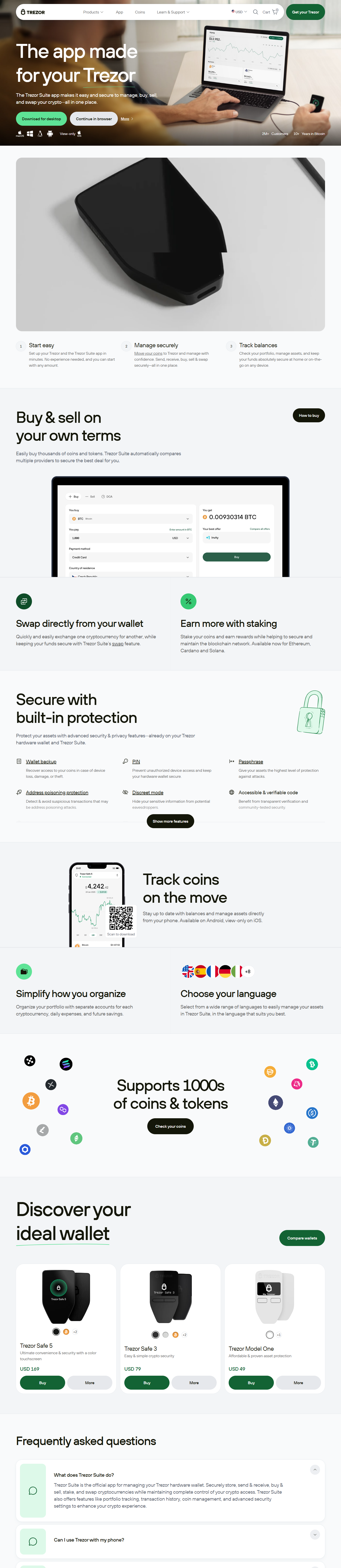
Trezor is one of the earliest and most respected hardware wallet brands for managing private keys offline. It stores your seed phrase and signs transactions on a small USB device, keeping secret keys isolated from your computer and phone. This review covers security posture, supported cryptos, fees, everyday use, pros and cons, and a short FAQ.
What is Trezor?
Trezor is a line of hardware wallets developed by SatoshiLabs. The devices — commonly the Trezor Model One and the Trezor Model T — are compact, tamper-resistant USB devices with a small display and buttons (or touchscreen on the Model T). They hold your private keys offline, requiring physical confirmation on the device to authorize transactions. This model prevents malware on your computer from exfiltrating keys.
How it works (high level)
- Initialize the device and create a new recovery seed (usually 12–24 words).
- The device generates and stores the seed and derived private keys; those never leave the device.
- When you want to send crypto, the unsigned transaction is sent to the device for signing.
- You verify transaction details on the device screen and approve to sign. Signed transaction is returned and broadcast by your computer or phone.
Key idea: the private keys never touch the internet — only signed transactions leave the device.
Model differences
The Model One is the budget option: robust, open-source, and works with many coins via Trezor Suite or third‑party wallets. The Model T adds a color touchscreen, faster CPU, microSD support for some advanced features, and wider native coin support. Choose Model One for low cost and reliability, Model T for usability and future-proofing.
Security: how safe is Trezor?
Trezor uses well-understood cryptographic primitives and a secure element-like approach (though the Model One does not include a secure element, it relies on open-source firmware and community scrutiny). Security features include PIN protection, passphrase support (hidden wallet), firmware signing, and a recovery seed that you control. If properly initialized and purchased from an authorized seller, the device offers markedly stronger protection than software wallets or exchange custody.
Common attack vectors
- Physical theft: An attacker with device+PIN brute force time is limited; passphrase adds another layer.
- Supply-chain tampering: Buying from unofficial sellers risks a modified device. Always buy from Trezor or trusted retailers.
- Phishing and fake websites: Always use the official Trezor Suite or verify firmware signatures.
Best practices
- Buy new and sealed from official channels.
- Verify device authenticity and firmware before use.
- Write your recovery seed on a metal backup if you store large balances.
- Consider a passphrase (but store it securely — losing it can mean permanent loss of funds).
Fees and costs
Trezor itself does not charge per-transaction fees. Fees you pay are network fees (miners/validators) required by the blockchain to process transactions. There are, however, several cost considerations:
- Device cost: One-time purchase. Model One is the cheaper option; Model T is pricier.
- Accessory costs: USB-C adapters, microSD (for optional features), or protective cases may add cost.
- App integrations: Trezor Suite is free. Some third-party services integrated with Trezor (exchanges or swap providers) may charge service fees or spread on swaps.
- Recovery tools: Metal backup plates or services for seed storage are optional but recommended for large holdings.
When sending crypto from a Trezor, you control the network fee through the interface (Trezor Suite or compatible wallet). Higher fees speed up confirmation; lower fees may delay your transaction. For certain coin swaps executed inside Trezor Suite or third-party apps, expect a service fee or exchange spread — always inspect rates before confirming.
Supported cryptocurrencies
Trezor supports hundreds of coins either natively or via integrations. Commonly used coins include Bitcoin (BTC), Ethereum (ETH) and ERC‑20 tokens, Litecoin (LTC), Bitcoin Cash (BCH), Cardano (ADA via third‑party bridge), and many more. The Model T has broader native support especially for newer chains and tokens; the Model One supports core coins and relies on third‑party bridges for certain token standards.
How tokens are handled
For tokens built on widely supported standards (e.g. Ethereum ERC‑20), Trezor signs transactions while a connected application (like MetaMask or Trezor Suite) displays token balances. For some newer or niche blockchains, you may need to use community-maintained bridges or wallet integrations.
Before buying crypto specifically to hold on Trezor, check the current support list at the official Trezor site or in Trezor Suite to confirm native support and any required third‑party wallet steps.
Everyday use: setup and workflows
Initial setup
- Unbox and inspect the device packaging for tamper evidence.
- Connect to Trezor Suite (official app) or a recommended third‑party wallet.
- Create a new wallet and write down the recovery seed shown by the device—never save the seed digitally.
- Set a PIN and optionally enable a passphrase for hidden wallets.
Receiving and sending
Receiving is as simple as sharing a receiving address from the suite. Sending requires you to connect the device, prepare a transaction in the app, review the details on the device screen (critical step), and physically confirm the transaction to sign.
Integrations
Trezor integrates with major wallet interfaces and services: Trezor Suite (desktop & web), MetaMask, Electrum, Wasabi (for Bitcoin privacy), and various DeFi web apps (via WebUSB or bridge). These integrations let you use Trezor for DeFi while keeping keys offline.
Pros, cons and who it’s for
Pros
- Strong security model with offline key storage.
- Open-source firmware for community audits.
- Wide coin support and good wallet integrations.
- Easy to use for beginners and flexible for power users.
Cons
- Device cost upfront compared to free software wallets.
- Requires careful seed backup practices — human error can cause loss.
- Not ideal for high-frequency traders who need instant access on exchanges.
- Supply-chain risks if purchased from unofficial retailers.
Best for: long-term holders, users who value self-custody and security above convenience, and people managing medium to large crypto balances. Not ideal for casual users who prefer exchange custody or for those who dislike managing physical backups.
Comparison: Trezor vs other hardware wallets
Trezor competes most directly with Ledger and a handful of other hardware apps. The general differences are:
- Open-source vs closed-source: Trezor’s firmware is open-source; Ledger uses a closed-source secure element. This leads to different trade-offs between auditability and hardware-level secure element protections.
- Coin support: Both support major coins; Model differences influence niche support.
- UX: Trezor Model T’s touchscreen is more user-friendly; Ledger Live’s UI is polished and has many built-in features.
Choose based on which trade-offs you prioritize: open-source transparency and community trust (Trezor) or hardware secure element and vendor-controlled firmware approach (Ledger).
FAQ
Can I recover my wallet if the device is lost?
Yes — if you have the recovery seed. The seed can be restored on another Trezor or compatible wallet that accepts the same seed standard. If you lose both the device and the seed, funds are irretrievable.
Does Trezor charge transaction fees?
No — Trezor does not charge blockchain transaction fees; network fees apply and third-party swap services may add fees.
Is Trezor safe for DeFi?
Yes — it’s commonly used for DeFi when combined with an interface like MetaMask or Web3 apps, because signing happens offline. But always double-check which contracts you approve when interacting with DeFi.
Final verdict
Trezor remains one of the top hardware wallet choices for people who prioritize security, transparency, and control. Its open-source nature, solid ecosystem, and reliable devices make it an excellent option for self-custody. The initial cost and responsibility of seed backups are the main downsides, but for most long-term holders the trade-off is worth it.
If you hold significant crypto value and want to keep keys off the internet, Trezor is a practical, well-documented, and community-audited choice.